


Information Flows#
The Open Archival Information System (OAIS) reference model is generally very high-level. There are a lot of different ways of running an archive that would still fit.
But one thing it is very clear about is the overall flow of information through the archive.
Flow 1: The Line#
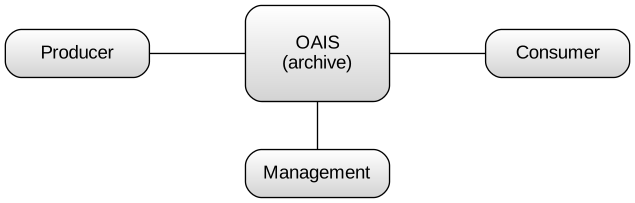
OAIS §1.4 - CONFORMANCE: “A conforming OAIS Archive implementation shall support the model of information described in 2.2”
OAIS §2.2.3 - INFORMATION PACKAGE VARIANTS: “Within the OAIS one or more SIPs are transformed into one or more Archival Information Packages (AIPs) for preservation. […] In response to a request, the OAIS provides all or a part of an AIP to a Consumer in the form of a Dissemination Information Package (DIP). “
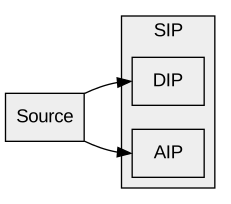
Under OAIS, Submission Information Packages (SIPs) come in from Producers, are managed as Archival Information Packages (AIPs), and these AIPs are then used to generate the Dissemination Information Packages (DIPs) that serve the needs of the archive’s user community a.k.a. Consumers. This fundamental design pattern for digital archives – this way of describing the overall flow of archival information – can be visualised as follows:
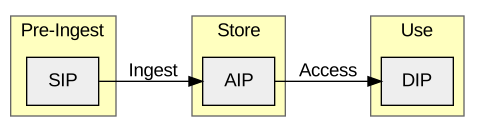
Or simply:

This linear flow is one of the strengths of the OAIS model, because by generating the DIP from the AIP, we ensure that all the information we might need to (re)create a new DIP is in the archive.
For an implementation to follow this pattern, it must ensure that only information that is in the AIP was used in the creation of the DIP, and there is no dependency on the SIP. OAIS does this by specifying that the DIP is generated from the AIP held on Archival Storage, after the SIP has been discarded. This could be immediately after ingest, or some time later, or on demand – the important thing is that it’s post-ingest. To understand what this means in practice, it is useful to look at some examples of digital archives that work in this way.
The UK Web Archive#
Like most web archives, the UK Web Archive generates access copies on demand. Before that can happen, the archived web resources are captured in WARC files, which are then placed on archival storage before the necessary indexes are generated from them in order to enable access. When individual items are requested, the relevant records are looked up in the indexes before being copied from the AIP, and the access version (DIP) is generated from the archival version during the playback process.[1]

Because the transformation is done on demand, this makes it easier to modify how playback is performed in response to changes in web technology. In essence, we preserve the software that gives us the ability to generate access copies, rather than preserving the access copies directly.
The Internet Archive#
While their web archive generates derivatives on demand (as above), the Internet Archive’s documentation makes it clear that their archival system generates various derivatives for items after they have been ingested/uploaded, depending on the content. See for example this documentation on type of derivatives they generate, and this summary table showing all the format conversions they do. The derivatives are stored rather than re-generated on demand, but doing this post-ingest means the derivation process can’t block the process of ingesting items and ensuring they are safely replicated.

Note that the Internet Archive documentation does not talk in terms of SIPs AIPs and DIPs. The information packages are simply referred to as Items throughout, where an Item is essentially a collection of files and (optional) sub-folders. More emphasis is placed on explaining the Upload and Derive processes, e.g. how different file formats and configurations are interpreted during the generation of derivatives.
Flow 2: The Stop#
The linear workflow described above may seem obvious, perhaps even inevitable, but it’s not. Indeed, it’s not unusual to find archives where there is no outflow at all. This corresponds to so called “dark archives” - ones that cannot be accessed except by the people who manage the archive. Usually, this is because the content is available elsewhere, and the archive is acting as a ‘backup copy’ in case the original goes away.

In these cases, the focus tends to be on ingesting the content, and not on how that content might be used in the future. There may be DIPs, but they are not well tested because no-one really uses them much. Or there may be no DIPs at all, or just some theoretical DIP based on an imagined future. The danger here is that it’s possible to miss some information you need from the SIP, or from the wider context, because you’d only realise you needed it when your user community started trying to access the material. Ideally, to mitigate against this risk, it is necessary to either encourage real usage, or at least simulate it, so that access problems can be identified while there is still some hope of resolving them. Otherwise, your AIPs are like a backup that’s never been tested.
The UK Web Archive#
While the UK Web Archive has thousands of open-access websites, we also archive many millions of sites that can only be accessed under Non-Print Legal Deposit terms. This places heavy restrictions on access to those sites, and this combined with our limited capacity for manual quality assurance means it is unlikely that many of these archived pages will be viewed quickly enough to pick up any issues while we can still resolve them. One way we are trying to mitigate this risk is by starting to automate some of the manual QA processes. For example, for many years we have been collecting screenshots of how the websites looked when the web crawler originally visited them. The next step will be to add a post-ingest process that takes a screenshot of the archived web page in the same way as the crawler, allowing the images to be directly compared. This should highlight any issues and focus our efforts on where things needs to be improved. We have also been working on publishing non-consumptive datasets based on our holdings. These are no substitute for the original web pages, but the surrogates are rich enough that meaningful research can be done with them, and this can help identify gaps in our collection.
Electronic Journals#
Due to their importance and economic value, eJournals are often ‘backed up’ in dark archives like CLOCKSS or Portico. Usually, access to eJournals is via the publisher sites, and the archived copies only become active if the publisher shuts down. Here, AIPs usually contain all the SIP information, but ensuring the completeness of these packages is highly dependent on how fully the structure and content can be validated. This is particularly challenging when it come to the handling of supplementary material, as this can come in a wide range of formats, or may only be supplied as a reference to resources held elsewhere.
Flow 3: The Fork#
The final class of information flow breaks the linear model entirely: while there is always a line from ingest to access[2], there is sometimes a fork in the road.
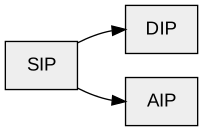
In this kind of split workflow, both the AIP and the DIP are generated directly from the SIP. In contrast to the linear flow, this design pattern does not automatically ensure that the AIP contains all the information we need to generate the DIP. This is not to say that this risk cannot be addressed, rather the point is that the implementation has to do additional work to make sure that this is the case.
One of the reasons why this can happen is that, during the design and implementation of archival workflows, it is common to try and perform a lot of processing up-front. Schematically, the result can look something like this:
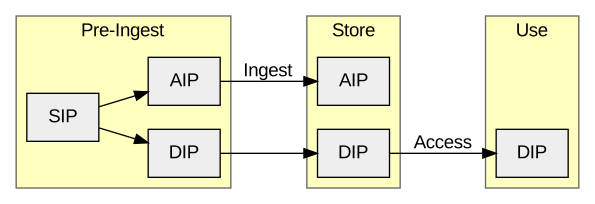
Here I am using Ingest, Store and Access to identify processing contexts, covering all the functions associated with that phase of the workflow. During the Ingest phase, the incoming packages have been used to generate the DIP before the AIP has been transferred to the archive store. This means it is possible for the AIP and DIP to diverge.
In many cases, especially those where the critical payload of each package is a single file, this is a modest burden, because when the number of files involved is small, it’s easier to keep track of individual files, their checksums, and their relationships. As things get more complex, it becomes easier for errors to creep in, especially if some network or system outage occurs while an item is being processed. These potential risks are certainly manageable - the point is simply that these risks arise because of the decision to perform more processing up front. This does not mean “The Fork” is a bad pattern, indeed in those cases where we can confidently verify the packages are complete, this means we can pick up problems before items make it to the archival store. The downside is that if there are problems during ingest, this can lead to a backlog of material that spends far too long stuck on non-archival storage.
An Outsourced Digitization#
This example involves a digitization project where much of the work had been outsourced to a third-party. The decision had been made to get the external partner to generate “access copies” as well as the long-term “preservation copies”. The preservation version consisted of high-resolution, full page TIFF files and associated metadata tying each set of TIFFs together, mapping back to the original publication. However, the access versions were not simply JPEGs of the preservation versions, because the items were broken up at the level of individual articles. This worked well for access purposes at the time.
The problem was the article segmentation process had not been properly documented. The coordinates on the TIFF version that corresponded to the positions of the JPEG versions had been lost. This meant that when the access system became obsolete, it was not be possible to replace it like-for-like, i.e. while still preserving the same article-level experience.
Preservation System Design#
When looking at tools and services that implemented digital preservation processes, it can be very difficult to tell exactly what’s going on under the hood and therefore difficult to determine what kind of information flow is being implemented. However, both Archivematica and Rosetta have a significant amount of documentation that is openly accessible online, so this allows is to gain some insight into how things are done.
Reading the Archivematica documentation it is clear that Archivematica usually performs all processing up front, prior to ingest: the DIP is clearly generated directly from the SIP, but the system takes steps to ensure nothing is lost by making the original SIP form the basis of the AIP. Archivematica does make it possible to derive access copies in a post-ingest process as part of the ‘re-ingest’ workflow, but this is not the normal mode of operation. Rosetta also supports post-ingest generation of access copies via a Create Derivative Copy Representation workflow, but like Archivematica, this appears to be seen as a secondary mode of operation, with ingest-time processing being the primary focus.
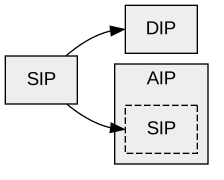
Note that this is not a criticism of these tools, which are merely implementing the workflow that their users have requested. Note also that it is not possible to draw comparisons with other preservation systems because this analysis is necessarily skewed towards those tools that provide detailed documentation online.
Flow 4: The Sidecar#
It’s also important to consider where the archival process fits into the wider environment, because the three primary patterns shown above can turn up in combination.
In this case, the digital preservation system may be running as a ‘sidecar’ service, alongside a live ‘Work In Progress’ (WIP) system that is used for managing digital resources and making them available to end users. i.e. there is some other organisation or team running their own repository or content/asset management system, which works well day-to-day but does not meet all the requirements of preservation requirements. For example, it may not be capable of managing the process of data replication, or handling formats preferred for preservation purposes.
To address these gaps, a ‘sidecar’ preservation service takes copies of items from the ‘Work In Progress’ system, leading to an overall information flow that looks like this:

This final picture combines both the Fork and the Stop patterns of information flow, and ends up working more like a backup than an archive.[3] As such, this kind of system design will need to address both the risks of gaps between the AIP and the real DIP that users actually use, and other, greater inconsistencies between the AIP and DIP, like whether there really is a preserved AIP for every DIP.
Indeed, because the overall archival function is being delivered by multiple separate systems (which may even be operated by different teams or organisations), the risk of missed dependencies and inconsistencies is greater still. It can also mean that the preservation service receives very little information about how end users are interacting with the content, preventing the service from engaging with the user community and detecting access difficulties and issues relating to obsolescence.
Access via Third-Parties#
There are many examples where memory organisations collaborate with third-parties to enable access to digitised material. Examples include things like the Google Books Library Project and the British Newspaper Archive, where large corporate entities create, manage and provide access to the digitised resources.
In these situations, the library or archive that is providing the print material usually received the digitised versions in return, and acts as the long-term backup service. In these cases, all the risks around completeness and user information need to be considered, and where possible, mitigations can be written into the formal partnership contracts.
Preservation-as-a-Service#
Due to the way cultural memory organisations are structured and funded, many are unable (or unwilling) to invest the significant resources required to make their systems meet digital preservation requirements. In this situation, off-the-shelf and cloud-based preservation systems are very appealing, as many of the risks around digital preservation can be outsourced to a dedicated service.
Here, the library or archive is not acting as an OAIS archive at all, and the third-party is working as the “long-term backup” version of an OAIS archive. Along with the risks around completeness and disconnection from the user community, this approach can present additional risks.
This is because the “long-term backup” is tied to a short-term contract, and therefore every few years it will usually be necessary to run a new procurement process which may or may not be awarded to the current contract holder. In the worse cases, this can mean the digital content itself may have to be moved over and over again between service providers, which is always a risky process. It is easy for small errors to lead to content getting missed or dropped, and there can be differences between the systems which make the migration complex and error-prone. This can be mitigated to some extend by attempting to take account of the migration costs during the procurement process, but the migration costs are hard to estimate accurately.
Finally, like all outsourced activities, there is the risk of being locked into a single vendor because the costs of migration have become so large.[4]
Summary#
The three distinct information flow patterns (and their possible combinations) show that there are fully-functional and widespread archival information flows that are not strictly OAIS conformant. This is not a problem with the archives or the software, but just alternative modes of operation that are not fully represented by OAIS as it stands. Each information flow pattern has it’s place, but it’s important to be aware of the balance of benefits and risks of each.